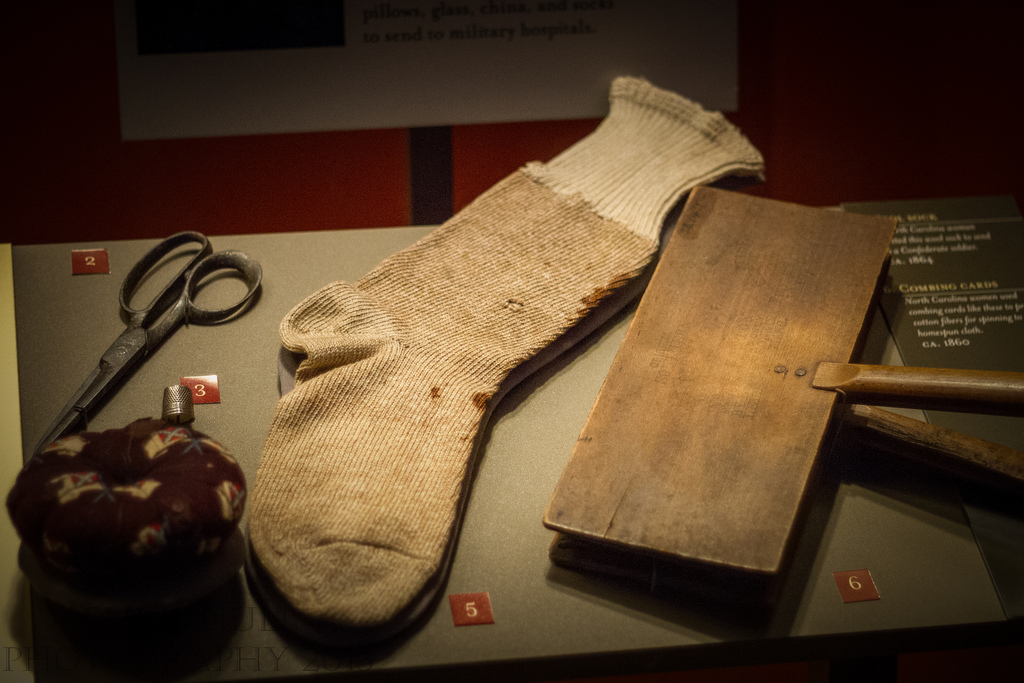
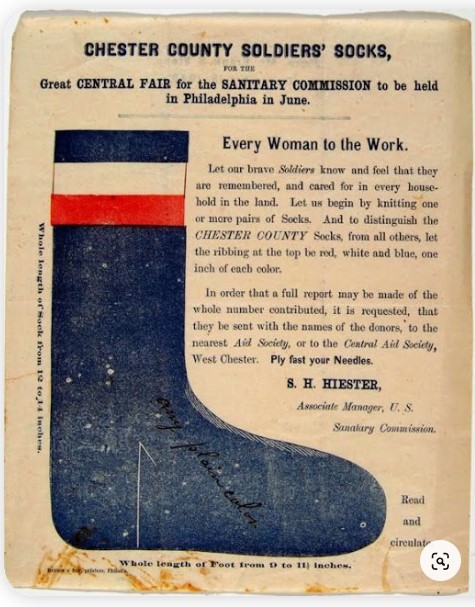
Starting in 1861, the Union Sanitary Commission called upon loyal women to knit socks for the soldiers. In this flyer, for example, residents of Chester County, PA were even asked to add distinguishing stripes.
The same call went out in the South, where soldiers were issued socks only twice a year. This poem by a soldier explains the desperate need.
EPISTLE TO THE LADIES.
Ye Southern maids and ladies fair.
Of whatsoe’r degree,
A moment stop—a moment spare,
And listen unto me.
The summer’s gone, the frosts have come,
The winter draweth near,
And still they march, to [text is unclear] and drum,—
Our armies!—do you hear?
Give heed then to the yarn I spin,
Who says that it is coarse?
At your fair feet I lay the sin,
The thread of my discourse.
To speak of shoes, it boots not here,
Our Q. M’s., wise and good,
Give cotton calf-skins twice a year.
With soles of cottonwood.
Shoeless we meet the well-shod foe,
And bootless him despise;
Sockless we watch, with bleeding toe,
And him sockdologize!
Perchance our powder giveth out?
We fight them, then with rocks,
With hungry craws we craw-fish not,—
But, Miss, we miss the socks.
Few are the miseries that we lack
And comforts seldom come;
What have I in my haversack?
And what have you at home?
Fair ladies then, if nothing loth,
Bring forth your spinning-wheels;
Knit not your brow,—but knit to clothe
In bliss our blistered heels.
Do not you take amiss, dear miss,
The burden of my yarn;
Alas! I know there’s many a loss!
That doesn’t care a darn.
But you can aid us, if you will,
And heaven will surely bless,
And Foote will vote to foot a bill
For succoring our distress.
For all the socks the maids have made.
My thanks, for all the brave,
And honored be your pious trade,
The soldiers sole to save.
From: Southern Punch, 11/14/1863
by W. E. M.” of Gen. Lee’s
army
A Brief History of Knitted Socks
Knitted socks only became popular in England in the 16th century. Before that most socks were made from cut and sewn fabric. At the start, people knit their own socks. As demand grew, knitting schools for poor children opened. Soon knitting socks became a source of income to large numbers of poor families. War, which required long marches, placed special demands on the men’s socks. Hand knitters were key in producing quantities of socks during the many wars of the period, including the American Revolutionary War.
And while knitting machines were developed in 1600s and began commercial production soon after, it was only by 1800 that machine production matched hand production. The Civil War again drew on hand knitters to meet the excessive demand for wool socks. This also occurred during World War 1.
For more on the history of sock knitting, check out: The History of Sock Knitting
For more on the need for socks during the Civil War: check out: The Feet of a Divided Nation
Civil War Sock Patterns
Here is a sock pattern from the same period. In the call for socks, it was specified they be 10 to 11 inches along the bottom of the foot. At the time, there were no standard needle gauges, leaving the knitter to find the right gauge by trial and error.

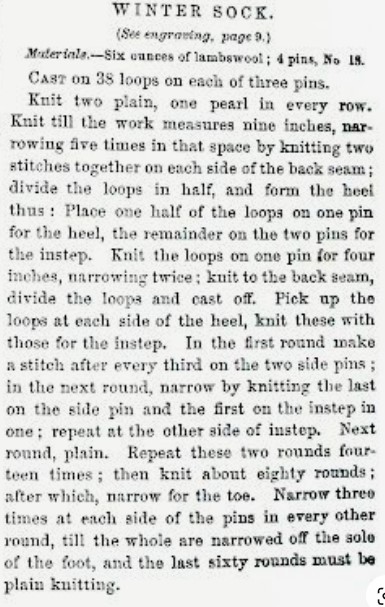
If you lived during the Civil War, would you have answered the call for socks? Could you have followed the pattern shown?
Discover more from American Civil War Voices
Subscribe to get the latest posts sent to your email.
 American Civil War Voices
Leave a comment